
solidhash.org Security Report & Trust Score
Category Crypto
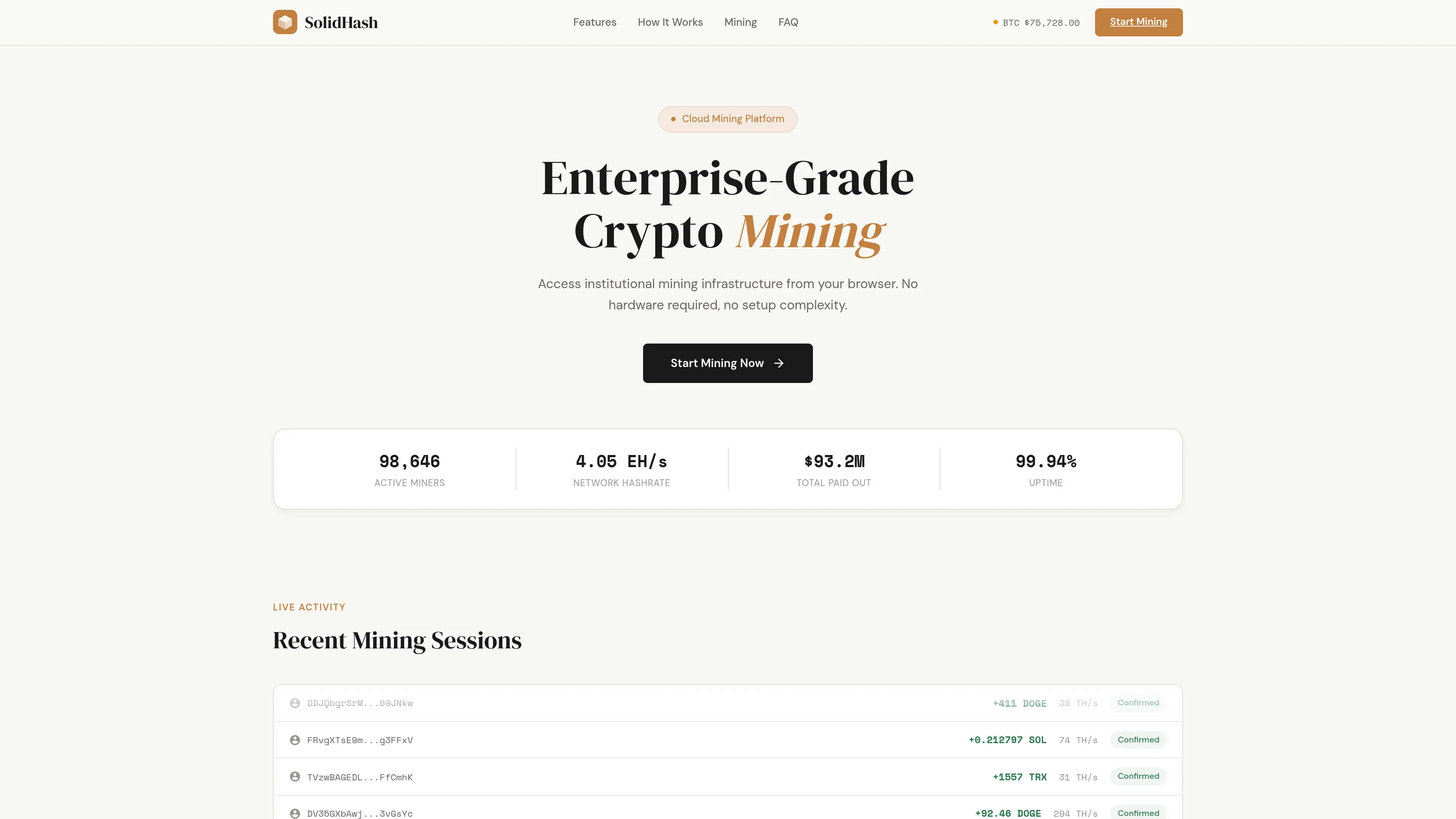
SolidHash is a cloud mining platform that allows users to mine multiple cryptocurrencies (BTC, ETH, SOL, and others) using remote GPU infrastructure accessible through a browser interface. The platform facilitates cryptocurrency mining as its primary business activity.
About solidhash.org
solidhash.org is a website categorized as Crypto. SolidHash is a cloud mining platform that allows users to mine multiple cryptocurrencies (BTC, ETH, SOL, and others) using remote GPU infrastructure accessible through a browser interface. The platform facilitates cryptocurrency mining as its primary business activity. It was last analyzed on April 21, 2026 and currently scores 35/100, which we rate as Elevated Risk.
The domain was registered 1m ago. It is registered through Global Domain Group LLC. The registration is set to expire on March 4, 2027. WHOIS privacy protection is enabled, so the registrant details are hidden. The domain is not signed with DNSSEC.
The site is hosted by AS13335 Cloudflare, Inc. in San Francisco, United States. It resolves to the IP address 188.114.97.3.
2 of 95 antivirus engines flag this domain.
With a trust score of 35/100, solidhash.org sits in an elevated-risk band. Several of the signals we track resemble patterns observed on problematic websites. Proceed with caution and verify the operator through independent sources before sharing money or data.
Think you've been scammed? Get a free consultation with cyber-intelligence experts
Is solidhash.org safe to use?
Based on our last scan on April 21, 2026, solidhash.org has a trust score of 35/100, which we rate as Elevated Risk. Several signals resemble patterns observed on problematic websites, so proceed with caution.
We found no official regulator warning on record for solidhash.org at the time of the last scan. Keep in mind that the absence of a warning is not proof of legitimacy: fraudulent platforms often operate for months before authorities list them. A legitimate investment service is normally registered with a recognized financial authority, such as the SEC, CFTC, FCA, ASIC or the regulator in your country, and that registration can be verified directly on the authority's own website. If a platform claims a license you cannot confirm at the source, treat that claim as false.
solidhash.org was registered only 1m ago. Very young domains deserve extra scrutiny: fraudulent operations typically abandon a burned domain and reappear under a new name within months, whereas established businesses usually build a much longer history on a single address.
2 antivirus engines already flag this domain. Detections tend to accumulate over time, so early flags on a young website are a meaningful warning rather than background noise.
How online scams like this operate
Most modern investment fraud does not start on the fraudulent website itself: it starts with a person. Operators build a fake relationship through social media, dating apps, messaging groups or an unsolicited message, sometimes over weeks or months, before casually introducing an "exclusive" investment opportunity. This long-grooming approach is widely known as pig butchering: the victim is patiently "fattened" with trust before the financial harvest begins.
The victim is then directed to a professional-looking platform. The dashboard, balances and trading charts shown there are fabricated and fully controlled by the operators. Small early withdrawals are sometimes honored on purpose to build confidence and encourage a much larger deposit. When the victim finally asks to withdraw a significant amount, the tone changes: sudden "taxes", "release fees" or "verification charges" appear, and the account is frozen until they are paid. Every additional payment simply disappears.
A related tactic is the clone firm: scammers impersonate a genuinely licensed company, copying its name, logo and registration number while operating from a slightly different domain. This is why a license claim should always be verified on the regulator's own website, and why the exact domain name matters as much as the brand it displays.
Warning signs to watch for
- Unsolicited contact: a stranger, "advisor" or online acquaintance steering you toward a specific platform.
- Guaranteed returns: promises of fixed or unusually high profits with little or no risk.
- Pressure to act quickly: expiring bonuses, "last remaining spots", or warnings that the opportunity closes today.
- Unusual payment methods: requests to pay in cryptocurrency, gift cards, or by transfer to a personal account.
- Unverifiable license: a regulatory license that cannot be confirmed on the regulator's own register, or no license at all.
- Withdrawal problems: surprise "taxes", "release fees" or endless verification steps before you can access your own money.
- Only-up profits: a dashboard whose balance rises regardless of market conditions.
What to do if you already sent money
- Stop all communication: cut off the platform and whoever introduced you to it. Every additional contact is an opportunity for them to extract more money, including through fake "account managers" offering to fix the problem.
- Never pay a release fee: do not hand over a "tax" or "unlock charge" to recover a withdrawal. Legitimate services deduct fees from the balance; only scams demand extra money upfront.
- Alert your bank immediately: contact your bank or card issuer at once. Chargebacks and wire recalls are time-sensitive, so the sooner you report, the better your chances.
- Preserve the evidence: save screenshots of the platform and conversations, emails, transaction references and any wallet addresses you paid to.
- Report the fraud: notify your national cybercrime or consumer-protection authority, and the financial regulator in your country.
- Beware recovery scams: be wary of "fund recovery" agents who contact you afterwards and guarantee to get your money back for an upfront fee. Victim lists are resold, and recovery fraud is often the second act of the same scam.
Threats
2 / 95 engines flagged
Antivirus engines
2Blacklists
1 provider, all clear
- google_safe_browsing community
Identity
WHOIS
- amos.ns.cloudflare.com
- tiffany.ns.cloudflare.com
- client transfer prohibited
SSL
- *.solidhash.org
- solidhash.org
Server
 United States (US)
Screenshot
Forensics
Page timing
Network & resources
Cookies
1| Name | Domain | Flags |
|---|---|---|
| cf_clearance | .solidhash.org | Secure HttpOnly SameSite=None |
Technologies
1- Tailwind CSS css-framework
Uptime
Last 30 days
More reports
inoquant.com
39
 sagemaster.io
6
sagemaster.io
6
 biscoins.com
10
thetreasuryexchange.com
80
biscoins.com
10
thetreasuryexchange.com
80
 cropmines.com
5
cropmines.com
5
 digitifa.vip
44
digitifa.vip
44