

Nozbit (nozbit.com) Security Report & Trust Score
Category Crypto
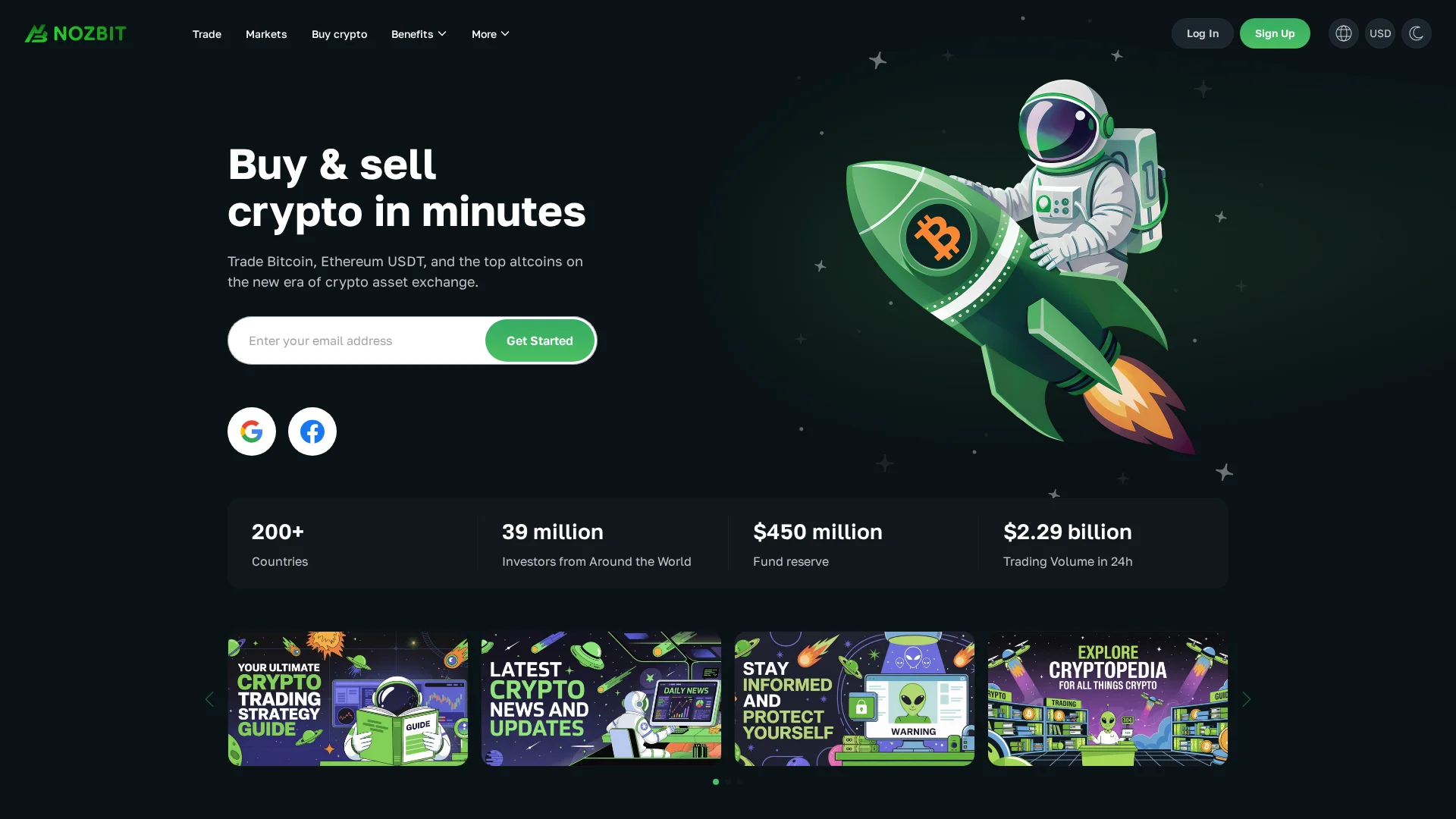
NOZBIT is a cryptocurrency exchange platform that allows users to buy, sell, and trade digital assets like Bitcoin and Ethereum, offering spot trading, futures contracts, copy trading, and automated bots.
About Nozbit
Nozbit is a website categorized as Crypto. NOZBIT is a cryptocurrency exchange platform that allows users to buy, sell, and trade digital assets like Bitcoin and Ethereum, offering spot trading, futures contracts, copy trading, and automated bots. It was last analyzed on April 30, 2026 and currently scores 44/100, which we rate as Elevated Risk.
The domain was registered 1y ago. It is registered through PDR Ltd. d/b/a PublicDomainRegistry.com. The registration is set to expire on April 15, 2027. WHOIS privacy protection is not enabled. The domain is not signed with DNSSEC.
The site is hosted by AS13335 Cloudflare, Inc. in San Francisco, United States. The server runs cloudflare. It resolves to the IP address 172.67.158.153.
2 of 91 antivirus engines flag this domain.
With a trust score of 44/100, Nozbit sits in an elevated-risk band. Several of the signals we track resemble patterns observed on problematic websites. Proceed with caution and verify the operator through independent sources before sharing money or data.
Think you've been scammed? Get a free consultation with cyber-intelligence experts
Is Nozbit safe to use?
Based on our last scan on April 30, 2026, Nozbit (nozbit.com) has a trust score of 44/100, which we rate as Elevated Risk. Several signals resemble patterns observed on problematic websites, so proceed with caution.
We found no official regulator warning on record for Nozbit at the time of the last scan. Keep in mind that the absence of a warning is not proof of legitimacy: fraudulent platforms often operate for months before authorities list them. A legitimate investment service is normally registered with a recognized financial authority, such as the SEC, CFTC, FCA, ASIC or the regulator in your country, and that registration can be verified directly on the authority's own website. If a platform claims a license you cannot confirm at the source, treat that claim as false.
2 antivirus engines already flag this domain. Detections tend to accumulate over time, so early flags on a young website are a meaningful warning rather than background noise.
The typical playbook of these scams
Think of the scam website as the last stage, not the first. What sets it in motion is human contact: an unsolicited message, a new "friend" from a dating app or messaging group, or a warm introduction on social media. That contact is cultivated patiently, often for weeks or months, until an "exclusive" investment tip feels like a natural next step. The industry name for this drawn-out grooming is pig butchering, a grim reference to fattening the target with trust before the payoff is taken.
With trust established, the target is funneled onto a polished platform whose numbers are pure fiction: the balances, the charts and the returns are all manufactured and steered entirely by the operators. A modest early withdrawal is occasionally allowed, a deliberate move to lower the victim's guard and invite a much bigger deposit. Try to cash out a meaningful amount, though, and everything changes: fresh "taxes", "release fees" or "verification charges" are demanded, the funds are held hostage until those are settled, and whatever you send after that vanishes.
Running in parallel is the clone firm, where scammers dress themselves up as a genuinely licensed business, reusing its name, logo and registration number, while quietly operating from a near-identical domain. It is the reason a stated license is only meaningful once you confirm it on the regulator's own website, and the reason the precise domain name carries just as much weight as the familiar brand shown beside it.
Signals that should make you pause
- A guide you never asked for: a "coach", acquaintance or new online contact keeps steering you to one named site.
- Risk-free pitch: profits are framed as safe and dependable, locked-in, sky-high, and supposedly free of any real downside.
- Constant countdown: a relentless rush to commit, with disappearing bonuses or a deadline that always seems to be today.
- Private-account transfers: they ask to be paid in cryptocurrency or gift cards, or by sending money straight to a private individual's account.
- Missing from the register: their claimed authorization does not show up on the regulator's own register, assuming any license is mentioned at all.
- Funds held back: getting your money out proves difficult, with fresh "taxes", "release fees" or repeated checks standing between you and your funds.
- Straight-line gains: on screen the profits rise in a straight line, entirely detached from how the real market is moving.
Already lost money? Here is what to do next
- Break off every line of communication: step away from the platform and from whoever steered you toward it. Staying in touch only hands them fresh chances to take more, often through a fake "account manager" who pretends to be there to help.
- Pay nothing to unlock funds: do not send a single "release fee", "tax" or "unlock charge" to set a withdrawal free. Genuine providers subtract their fees from what you already hold; only fraudsters insist on extra money before you see a cent.
- Contact your bank without delay: reach out to your bank or card issuer as soon as you can. Because chargebacks and wire recalls have tight deadlines, acting fast is what gives you a realistic chance of getting money back.
- Save the proof: capture screenshots of the platform and your conversations, and hold on to emails, transaction references and any wallet addresses you paid into.
- Notify the regulators: alert the cybercrime or consumer-protection authority in your country, along with your national financial regulator.
- Distrust recovery pitches: treat any "fund recovery" firm that later promises to retrieve your losses for an advance fee with deep suspicion. Lists of victims are traded around, and this pitch is commonly the same scam coming back for more.
Threats
2 / 91 engines flagged
Antivirus engines
1Security vendors
1Blacklists
1 provider, all clear
- google_safe_browsing community
Identity
WHOIS
- princess.ns.cloudflare.com
- skip.ns.cloudflare.com
- client transfer prohibited
SSL
- nozbit.com
- *.nozbit.com
Server
 United States (US)
Extracted contacts
Contact details found on the site and in regulator warnings, shown for identification only. Do not contact them.
Emails
4- business@nozbit.com
- cooperation@nozbit.com
- customer@nozbit.com
Show 1 more
- media@nozbit.com
Social profiles
4- twitter: @nozbit_exchange
- facebook: @nozbitnews
- instagram: @nozbit_news
Show 1 more
- telegram: @nozbit_exchange
Screenshot
Forensics
Page timing
Network & resources
Cookies
3| Name | Domain | Flags |
|---|---|---|
| XSRF-TOKEN | nozbit.com | — |
| exchange_session | nozbit.com | HttpOnly |
| io | nozbit.com | HttpOnly |
Technologies
2- Cloudflare cdn
- Tailwind CSS css-framework
Uptime
Last 30 days
More reports
arbnix.com
25
apptop.link
1
 vonkex.com
1
vonkex.com
1
 rcx.cc
8
nummvix.com
1
novaplay.hk
1
rcx.cc
8
nummvix.com
1
novaplay.hk
1