

cryptofortune.live Security Report & Trust Score
Category Crypto
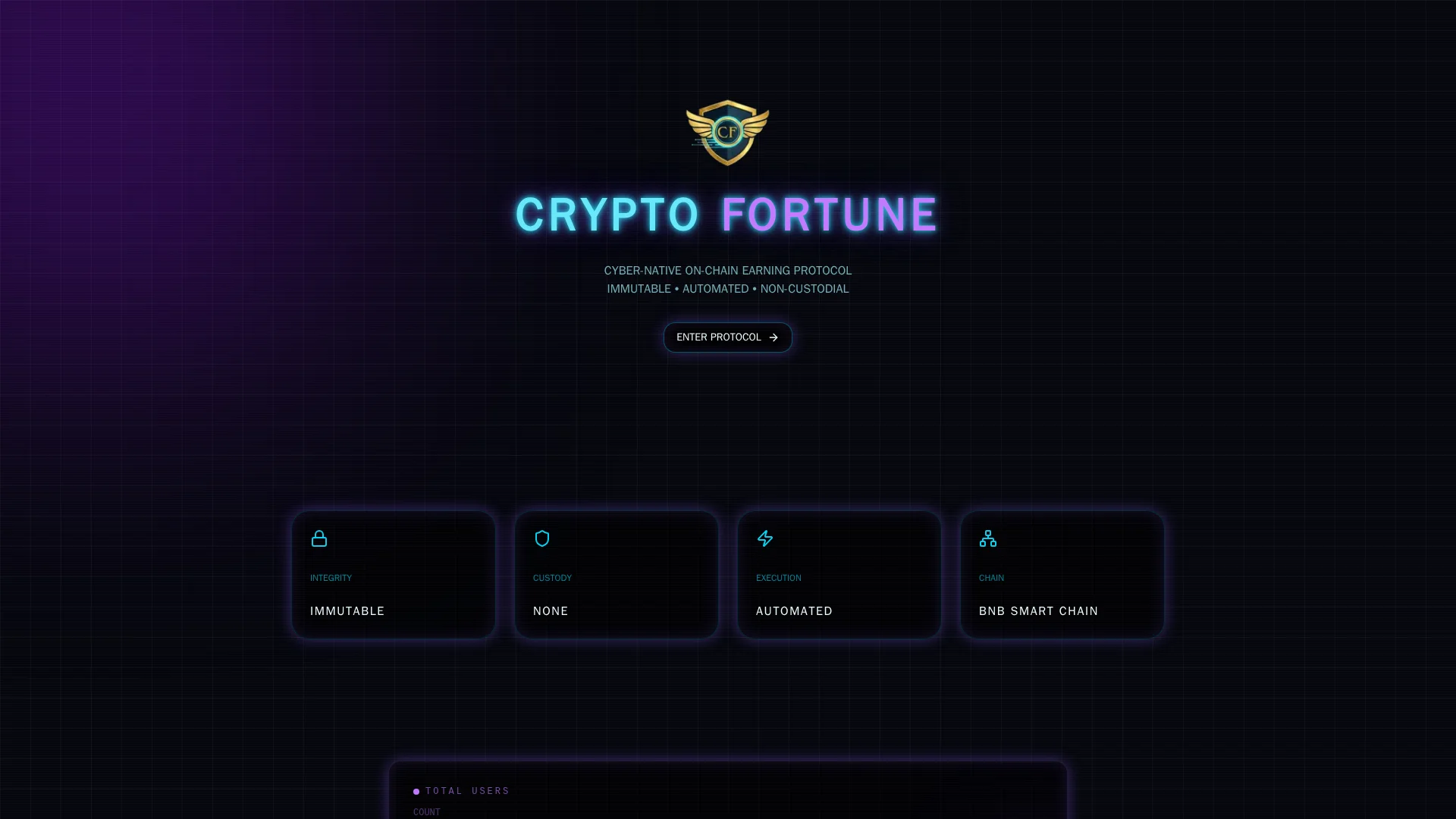
This site presents itself as an on-chain earning protocol built on BNB Smart Chain using smart contracts for automated rewards and token participation. It emphasizes decentralized, non-custodial operations with immutable smart contract logic.
About cryptofortune.live
cryptofortune.live is a website categorized as Crypto. This site presents itself as an on-chain earning protocol built on BNB Smart Chain using smart contracts for automated rewards and token participation. It emphasizes decentralized, non-custodial operations with immutable smart contract logic. It was last analyzed on April 30, 2026 and currently scores 41/100, which we rate as Elevated Risk.
The domain was registered 4m ago. It is registered through NameCheap, Inc.. The registration is set to expire on December 30, 2026. WHOIS privacy protection is enabled, so the registrant details are hidden. The domain is not signed with DNSSEC.
The site is hosted by AS16509 Amazon.com, Inc. in Walnut, United States. The server runs Vercel. It resolves to the IP address 216.198.79.1.
2 of 91 antivirus engines flag this domain.
With a trust score of 41/100, cryptofortune.live sits in an elevated-risk band. Several of the signals we track resemble patterns observed on problematic websites. Proceed with caution and verify the operator through independent sources before sharing money or data.
Think you've been scammed? Get a free consultation with cyber-intelligence experts
Is cryptofortune.live safe to use?
Based on our last scan on April 30, 2026, cryptofortune.live has a trust score of 41/100, which we rate as Elevated Risk. Several signals resemble patterns observed on problematic websites, so proceed with caution.
We found no official regulator warning on record for cryptofortune.live at the time of the last scan. Keep in mind that the absence of a warning is not proof of legitimacy: fraudulent platforms often operate for months before authorities list them. A legitimate investment service is normally registered with a recognized financial authority, such as the SEC, CFTC, FCA, ASIC or the regulator in your country, and that registration can be verified directly on the authority's own website. If a platform claims a license you cannot confirm at the source, treat that claim as false.
cryptofortune.live was registered only 4m ago. Very young domains deserve extra scrutiny: fraudulent operations typically abandon a burned domain and reappear under a new name within months, whereas established businesses usually build a much longer history on a single address.
2 antivirus engines already flag this domain. Detections tend to accumulate over time, so early flags on a young website are a meaningful warning rather than background noise.
How this kind of scam usually works
The website is rarely where the fraud begins; a real person usually is. A stranger reaches out first, on a dating app, in a chat group, through social media, or with a message you never asked for, and spends days or even months earning your trust before an "insider" or "exclusive" way to invest ever comes up. Investigators call this slow, deliberate grooming pig butchering, because the target is fed trust for weeks so the eventual loss is as large as possible.
Only after that trust is in place is the victim pointed to a slick, credible-looking platform. Everything it displays, from the account balance to the live charts and the growing profits, is invented and sits entirely under the operators' control. To seal the illusion, they may let you pull out a small sum early, which convinces you to wire in far more. The moment a serious withdrawal is requested, the story shifts: unexpected "taxes", "release fees" or "verification charges" surface, the balance is locked until you pay them, and each payment you make is simply gone.
The clone-firm trick works alongside this: fraudsters pose as a company that really does hold a license, borrowing its name, logo and registration number while running the show from a lookalike domain. That is precisely why any licensing claim has to be checked on the regulator's own site, and why the specific domain in the address bar deserves as much attention as the brand printed on the page.
Red flags worth paying attention to
- Approached out of the blue: someone you barely know keeps nudging you toward one particular platform.
- Too-good returns: profits pitched as certain, fixed or remarkably high while the risk is described as tiny or non-existent.
- Artificial urgency: you are hurried along by bonuses that expire, "only a few places left", or claims that the window shuts today.
- Odd payment channels: money is expected in crypto, in gift cards, or as a transfer into someone's personal account.
- Phantom license: the credentials they cite are impossible to find on the regulator's official register, or no license is offered at all.
- Blocked cash-outs: withdrawals are stalled by unexpected "taxes", "release fees" or never-ending verification hurdles.
- Impossible growth: the account balance climbs without fail, no matter what the wider market is actually doing.
Steps to take if you have already paid
- Cut off contact entirely: break away from both the platform and the person who brought you to it. Every further message gives them another chance to squeeze out more, sometimes via a bogus "account manager" who claims they can sort it all out.
- Refuse every extra charge: do not hand over any "release fee", "tax" or "unlock charge" in the name of freeing your withdrawal. Real services take their fees out of your balance; demanding more cash up front is a scam-only move.
- Call your bank right away: get in touch with your bank or card provider without delay. The window for chargebacks and wire recalls is short, so reporting early gives you the best shot at recovering anything.
- Keep everything as evidence: hold on to screenshots of the site and your chats, emails, transaction IDs, and every wallet address you sent funds to.
- Flag it to the authorities: report the fraud to your country's cybercrime or consumer-protection body, and to the financial regulator where you live.
- Stay sceptical of recovery offers: distrust "fund recovery" specialists who reach out later promising to claw your money back for a fee paid in advance. Victim lists get resold, and this "recovery" is frequently just the scam's second round.
Threats
2 / 91 engines flagged
Antivirus engines
2Blacklists
1 provider, all clear
- google_safe_browsing community
Identity
WHOIS
- dns1.registrar-servers.com
- dns2.registrar-servers.com
- client transfer prohibited
SSL
- www.cryptofortune.live
Server
 United States (US)
Screenshot
Forensics
Page timing
Redirect chain
1- https://www.cryptofortune.live/
Network & resources
Technologies
3- Next.js meta-framework
- Vercel hosting
- Tailwind CSS css-framework
Uptime
Last 30 days
More reports
 gerolax.com
2
hnocoin.com
42
xegamb.cc
1
cyphertraderai-app.com
1
gerolax.com
2
hnocoin.com
42
xegamb.cc
1
cyphertraderai-app.com
1
 suxxessfx.com
1
dlmqy.com
54
suxxessfx.com
1
dlmqy.com
54